


Daycare Drop-Off Zones Become Ice Rinks Faster Than Parking Lots—The Morning-Rush Trap

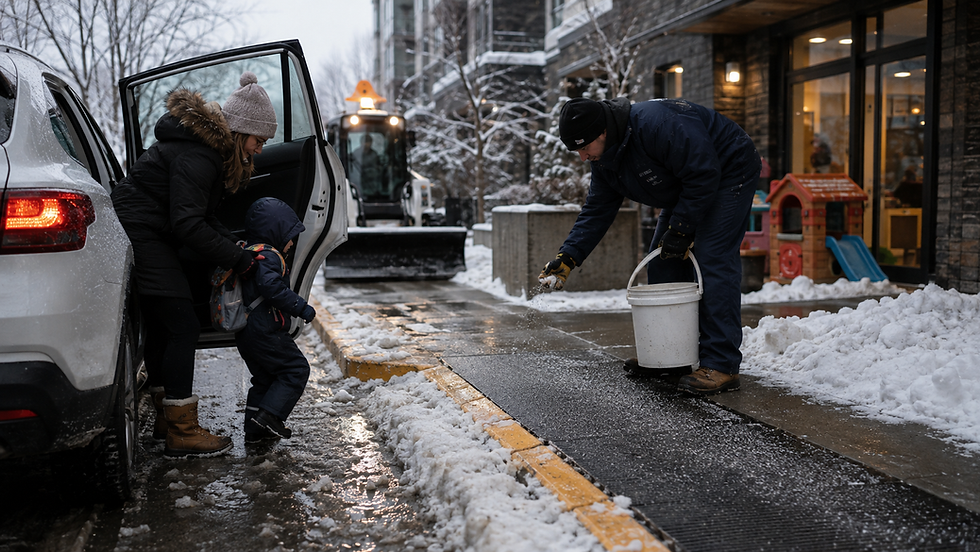
Why Daycare Drop-Off Zones Need a Separate Winter Risk Plan
A daycare entrance can look manageable at 5:30 a.m. and become the most dangerous part of a strata property less than two hours later. The reason is not necessarily deeper snow. It is concentration. Vehicles stop in the same narrow lane, adults step onto the same curb, children move through the same walkway, and meltwater repeatedly crosses a small area. That turns a modest winter event into a high-frequency traction problem.
For strata communities with an on-site or adjacent childcare facility, daycare snow removal should therefore be treated as a separate access problem—not simply as one more corner of the parking lot. The goal is to keep the complete route from vehicle door to building entrance usable during the short, intense periods when families arrive and leave.
The Hazard Starts Before the Parking Lot Looks Dangerous
A useful local comparison is winter-service coverage in New Westminster, where slope, shade, moisture and overnight refreeze can make pedestrian access risky even when visible accumulation is limited. A daycare drop-off zone intensifies the same problem because activity is concentrated into a very small footprint.
A general parking lot spreads tire traffic across stalls and drive aisles. A childcare entrance does the opposite. The same curb edge is crossed repeatedly. Snow is compressed by tires, then polished by boots. Parents may be carrying bags, holding a child’s hand or lifting a toddler from a vehicle, leaving less ability to recover from a slip.
The highest-risk surfaces are often not the centre of the lot. They are the curb cut, painted crossing, shaded sidewalk, drainage low point, ramp transition and first few metres outside the entrance. These should be mapped as priority surfaces before winter begins.
A Drop-Off Zone Needs Its Own Winter Service Plan
A complete Lower Mainland and Fraser Valley service area matters only if the operational plan remains specific at the property level. Regional coverage does not protect a childcare entrance unless crews know which surfaces must be ready before the first arrival wave.
Treat the Route, Not Just the Pavement
The service map should follow the parent’s actual path: approach lane, short-term stopping area, curb, walkway, stairs or ramp, and doorway. Mechanical clearing may handle open pavement, but narrow transitions often require hand work and targeted de-icing.
Snow piles also matter. A pile placed beside the drop-off lane can melt during the day and send water back across the curb route. If that runoff freezes before the next morning, the previous day’s snow clearing has created the next hazard.
Plan for the Second Freeze
The first visit is not always the decisive one. A wet afternoon followed by an overnight temperature drop can create winter drop off ice even after the snowfall has ended. A prevention plan should therefore include inspection and follow-up triggers based on refreeze risk, not snowfall depth alone.
Small Patch, Big Consequence
Winter Slip and Fall Statistics are useful because they show why seemingly minor walking-surface hazards deserve operational attention. WorkSafeBC reports that approximately 20% of workplace injuries involve slips, trips and falls, which can result in fractures, sprains, strains and concussions.
For a strata property, the broader lesson is simple: traction failures can have consequences far larger than the size of the icy patch.
Daycare access raises the stakes further. Morning users may be moving quickly, carrying children, pushing strollers or stepping between parked vehicles. A small untreated strip at a curb can therefore matter more than a much larger low-traffic section of parking pavement.
Good risk prevention focuses on exposure, not square footage. Service priorities should be based on how many people cross a surface, when they cross it and what they are doing at the time.
Why Elevation, Shade, and Refreeze Change the Morning Risk
The related winter conditions in Burnaby illustrate why one storm can create different conditions across nearby properties. Elevation, shaded surfaces, sloped lanes and freeze-thaw cycling can all change how long ice remains and how quickly meltwater refreezes.
The same principle applies inside a single strata site. A sunny visitor stall may be wet but safe while the covered daycare entrance remains frozen. An underground parkade ramp can stay clear while the curb above it develops a glaze. A sheltered walkway can preserve ice long after open pavement has thawed.
This is why daycare snow removal should not be triggered only by a visual check of the main lot. Crews need site-specific knowledge of shade, drainage, surface slope and repeat trouble spots. Preventive treatment should be concentrated where the microclimate and pedestrian load overlap.
The Five-Minute Rush Can Undo an Overnight Clearing
A page covering nearby winter-service coverage in Surrey provides another useful internal-link context because large service territories still have to account for local timing, drainage and changing precipitation. For childcare access, timing is especially important: a surface can be technically serviced yet poorly protected if the treatment is too early, too late or not checked after conditions change.
The morning rush can compress a thin residue of snow into a slick film. Vehicle tires can track slush into the lane, while daytime thaw and roof or canopy runoff can introduce additional water. The afternoon pickup window can then repeat the process on a surface that has changed since morning.
The practical answer is a service sequence built around actual use windows. Clearing before opening is essential, but so are post-treatment checks when temperatures hover near freezing and follow-up visits when meltwater is likely to refreeze.

Building a Safer Daycare Access Routine
Only Strata Snow Removal is well suited to this kind of narrow, high-frequency risk because its operating model is built around strata properties rather than generic commercial routes. Strict capacity limits help protect response reliability, while proactive dispatch allows crews to work around forecast conditions and peak access periods instead of waiting for a large accumulation trigger.
What Councils Should Map Before Winter
A pre-season plan should identify drop-off curbs, stroller routes, steps, ramps, downspouts, shaded zones, drainage depressions and acceptable snow-storage locations. It should also define when the childcare entrance takes priority over lower-risk parking surfaces.
Only Strata’s large salt reserves support continued de-icing during extended events, while compact crews and equipment can address shared residential access without treating the entire site as one uniform surface.
What a Service Record Should Prove
GPS and photo service logs should show when crews arrived, what areas were addressed and what conditions were observed. That documentation gives strata councils and property managers a clearer operational record than a simple invoice saying the property was “serviced.”
The company’s damage repair guarantee, cancellation flexibility and reliable winter response add practical protection around the service itself. But the most important advantage is the planning mindset: daycare access is managed as a timed pedestrian route with repeat ice exposure, not as leftover square footage after the parking lot is plowed.
For strata communities with childcare traffic, the safest winter plan is the one built around the busiest five minutes of the morning. Build a daycare access plan before the next freeze, map the surfaces families actually use and make refreeze follow-up part of the service—not an exception.


Comments