


Snow Removal Insurance BC: The Certificate Trap Strata Councils Should Not Sign Blindly
- Mikhail M.
- Aug 11
- 5 min read

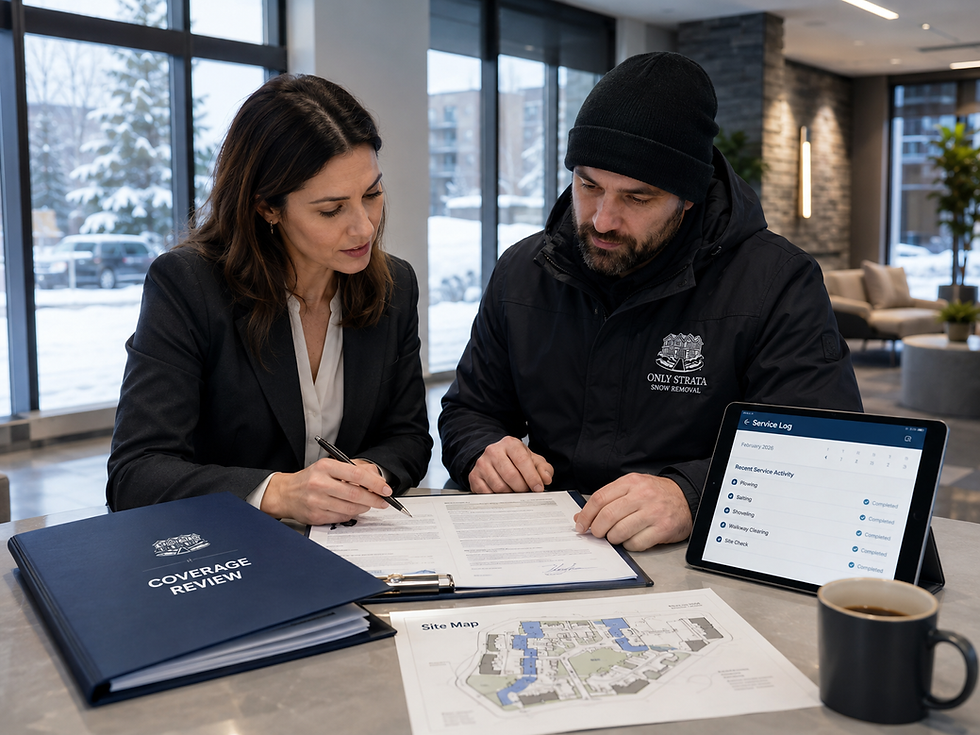
Residential Winter-Service Planning Starts With More Than a Certificate
A certificate of insurance can look reassuring. It has the contractor’s name, insurer, policy dates, coverage types, and liability limits. For a busy strata council reviewing winter quotes, it can feel like enough.
But snow removal insurance needs more scrutiny than a one-page document.
A certificate confirms that some insurance information existed when the document was issued. It does not automatically prove the contractor is properly covered for the work your property needs. It may not show exclusions. It may not confirm snow and ice operations are included. It may not prove your strata corporation is named as an additional insured. It may not tell you what happens if the policy changes, lapses, or excludes the exact type of claim that matters most during winter.
That is why Vancouver residential winter-service planning should treat insurance review as a procurement step, not a paperwork formality.
A Certificate Is a Snapshot
The certificate can show policy limits and effective dates. It does not replace the policy wording, endorsements, exclusions, or special conditions.
Coverage Details Decide the Risk
Snow removal insurance BC questions should focus on what the policy actually covers: plowing, salting, ice control, slip-and-fall allegations, property damage, subcontracted labour, and equipment operations.
A Complete Lower Mainland and Fraser Valley Service Area Needs One Insurance Standard
A complete Lower Mainland and Fraser Valley service area can involve different property types, weather conditions, equipment needs, and winter risks. A contractor serving multiple communities may work on dense condo sites, townhome lanes, parkade ramps, exposed sidewalks, visitor parking areas, and shared internal roads.
That variety makes insurance review more important, not less.
If a contractor offers broad snow and ice coverage, councils should ask whether the contractor’s insurance matches the actual scope of work. Does the policy cover snow and ice operations across residential strata properties? Does it include employees and approved subcontractors? Are equipment damage and property damage handled clearly? Are there exclusions that limit coverage during freeze-thaw or salting operations?
A strong snow removal insurance review should be consistent across the entire service area. The same standard should apply whether the site is compact, sloped, coastal, shaded, high-traffic, or spread across multiple buildings.
Only Strata Snow Removal’s strata-only focus helps make this review more practical because the work is built around shared residential access rather than generic commercial clearing.
Liability Mitigation in Snow Removal — Protecting Strata Communities from Costly Risks
Liability mitigation in snow removal — protecting strata communities from costly risks — starts before the first storm.
Councils often focus on response time, price, salt supply, and service scope. Those matter. But if the insurance review is weak, the property may be exposed when something goes wrong.
A winter incident may involve a resident slipping near an entrance, a vehicle sliding on a ramp, a plow damaging curbs, or equipment marking pavers. The question becomes: who is responsible, what records exist, and does the contractor’s insurance actually apply?
Ask About Additional Insured Status
Being listed as a certificate holder is not the same as being added as an additional insured. Councils should ask for the relevant endorsement or confirmation from the broker.
Ask About Snow and Ice Exclusions
Some policies may limit or exclude certain activities. A council should confirm that snow removal insurance covers the actual winter services being performed, including deicing, plowing, salting, and site work.
This is where documentation also matters. GPS/photo service logs, service records, salt application notes, and route confirmations help support the story of what happened on site.
Coverage Gaps Get Exposed When Conditions Change Fast
Winter risk rarely stays neat.
A property may be clear in the afternoon and icy by morning. Salt may be needed after plowing. A parkade ramp may refreeze because meltwater runs across the surface. A sidewalk may need handwork after a municipal plow creates a berm near the curb.
Related winter conditions in Burnaby can show why insurance and documentation should be reviewed before a service problem turns into a dispute.
If a contractor says the site was treated, the council needs service records. If a resident reports a fall, the property manager needs timestamps and photos. If equipment damages landscaping, curbs, or railings, the contract should explain repair responsibility and escalation.
A certificate of insurance alone does not answer those questions.
The stronger approach is to combine insurance verification with service verification. That means clear policy expectations, documented winter work, and a contract that explains who is accountable when conditions change.
Better Procurement Means Reading Beyond the Certificate
Nearby winter-service coverage in Richmond can raise similar insurance questions when wet snow, coastal refreeze, and repeated salting create changing surface conditions.
Before approving a snow contractor, councils should slow down and ask for the details behind the certificate. The goal is not to turn council members into insurance specialists. The goal is to know what needs to be reviewed by a broker, manager, or legal advisor before winter service begins.
Only Strata Snow Removal brings a strata-specific lens to this process. The company’s strict capacity limits, proactive dispatch, large salt reserves, GPS/photo logs, cancellation flexibility, and damage repair guarantee are designed around shared residential properties where service quality and accountability both matter.
The safest procurement decision is not simply choosing a contractor who sends a certificate quickly.
It is choosing a winter partner whose coverage, documentation, service model, and accountability can stand up to real snow and ice conditions.
A certificate may start the insurance conversation.
It should never end it.

The “Fully Insured” Line Can Hide Important Gaps
“Fully insured” is one of the most common lines in contractor proposals.
It is also one of the least specific.
A contractor can be insured and still not have the right coverage for your property’s risk. The limits may be too low. The policy may not name the strata as required. Subcontractors may not be handled clearly. Certain winter operations may be restricted. Damage repair expectations may not be aligned with the contract.
For snow removal insurance BC review, councils should ask practical questions:
What are the liability limits? Are snow and ice operations included? Is the strata corporation named correctly? Are subcontracted snow crews covered? Is there a waiver of subrogation if required? Does the contractor carry appropriate vehicle and equipment coverage? Who should the property manager contact to verify the policy?
Only Strata Snow Removal supports stronger procurement confidence through reliable winter response, GPS/photo service logs, proactive dispatch, a damage repair guarantee, strict capacity limits, and large salt reserves.
Insurance is still a legal and broker-level review, but better operations create better records when councils need clarity.


Comments