


Beyond a Shovel-Width Trail: 7 Signs Your Crew Actually Finished the Job

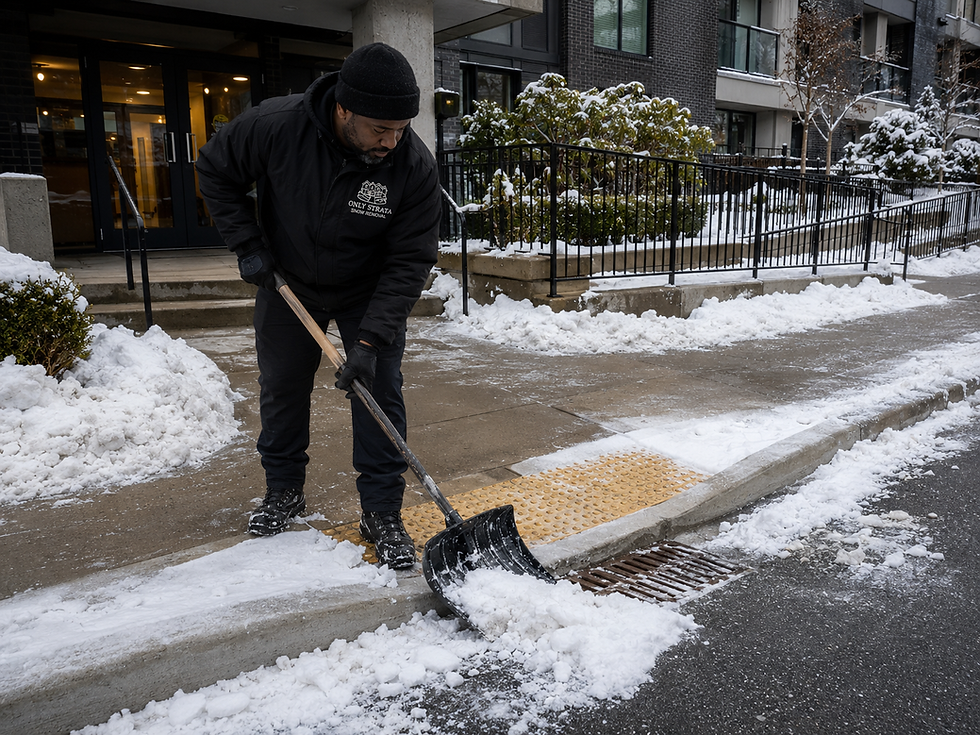
Good Work Starts at the Edges
Anyone can push enough snow aside to create a narrow route from one point to another. Quality hand clearing is different. On a strata property, the finished result should be something a council or property manager can actually inspect.
The first sign is surface exposure. A crew should remove loose accumulation rather than leave a compressed layer that residents immediately walk into a slick surface. Conditions may prevent perfectly bare concrete every time, but obvious shovelable snow should not remain simply because a passage exists.
The second sign is usable width. Entrances, sidewalks, stairs, and pedestrian connections should be cleared to the agreed boundaries rather than gradually shrinking into single-file trails.
This is an important distinction when evaluating winter access service in Chilliwack. A completed route should reflect the contracted scope, not merely demonstrate that someone visited the site.
The third sign is visible at the borders. Straight, recognizable edges show that crews know where the walkway ends and landscaping begins. That matters for both accessibility and property protection.
Consistency Is a Capacity Question
Hand clearing can be deceptively labour-intensive. A truck may move a large amount of snow quickly, while one employee can spend considerable time working through stairs, narrow passages, entrance pads, garbage areas, and spaces around parked vehicles.
For a contractor operating across a complete Lower Mainland and Fraser Valley service area, consistent workmanship therefore depends on having enough people assigned to the storm—not simply enough plow trucks.
The fourth sign: snow is placed deliberately
A quality crew does not shovel snow into the nearest available space without considering what happens next.
Snow should not be piled across drainage routes, against frequently used doors, over utility access points, or where the pile will narrow the walkway during the next storm. Sightlines and future snow-storage capacity also matter.
On a strata property, hand crews often have to make dozens of small placement decisions that cannot be solved by a single equipment pass.
The fifth sign: critical access remains accessible
Good workmanship becomes obvious around details that are easy to ignore.
Fire-access points, building entrances, gates, mail areas, waste enclosures, ramps, and other required routes should not disappear behind a pile created during the clearing process.
Only Strata Snow Removal's strata-only focus is relevant here because shared residential sites are rarely a collection of identical walkways. Crews need site-specific instructions and enough time to execute them properly.
Strict capacity limits help protect that time instead of forcing employees to rush from property to property.
Seven Signs Turn “Looks Fine” Into a Real Inspection
Councils do not need to become snow-removal experts to evaluate workmanship. They need a repeatable standard.
The useful question raised by Snow Plowing vs Snow Clearing in Vancouver: What Strata Councils Actually Need to Book to Stay Safe applies equally to handwork: what result was actually purchased?
A practical seven-point inspection looks for:
loose snow removed as close to the walking surface as conditions reasonably allow;
the agreed usable width restored rather than a narrow channel;
clean walkway and stair edges;
snow stored without blocking drainage, access, or visibility;
entrances, ramps, utilities, and important pedestrian connections kept usable;
landscaping and hardscape left without obvious service-related damage;
ice-control material applied deliberately where the contract calls for it.
This is far more useful than judging a snow shoveling service by how neat the property appears in one photograph.
The strongest standard is measurable: specified surfaces, specified widths, known priorities, and documented completion.
The Real Test Often Comes After the Crew Leaves
Freshly cleared pavement is only a snapshot of the property. Meltwater, temperature changes, foot traffic, roof runoff, and additional precipitation can change the surface later.
That is why snow shovelling quality includes thinking one weather step ahead.
The sixth sign: drainage has not been ignored
The significance of related winter conditions in Abbotsford becomes clear when piled snow begins melting.
If hand crews pack snow tightly around a catch basin or push it into a natural drainage path, water may later move across an entrance or walkway. A temperature drop can then turn a successfully cleared area into an ice problem.
Quality crews notice low points, drainage grates, downspout discharge, and recurring runoff patterns. They do not need to redesign the property, but they should avoid creating obvious problems with their own snow placement.
The seventh sign: ice control is targeted, not careless
More material is not automatically better.
Where granular treatment forms part of the scope, application should respond to conditions and priority surfaces rather than become a heavy blanket spread everywhere. Only Strata maintains substantial salt reserves so supply shortages are less likely to dictate service decisions during a busy weather event.
Ice control should still be treated as a defined task. A council should know which surfaces receive treatment, when it is triggered, and whether later refreeze conditions require another visit.
Photos Should Prove More Than Attendance
A timestamp showing that a worker arrived is useful. It does not, by itself, demonstrate workmanship.
For councils considering nearby winter-service coverage in Hope, proof of service becomes more useful when photographs correspond to recognizable completion points: an entrance, a stair set, a primary walkway, or another defined priority area.
Only Strata uses GPS and photo service logs to create that stronger record. Proactive dispatch provides another layer of operational control because crews do not have to depend entirely on a manager noticing deteriorating conditions and making the first call.
Documentation also helps when expectations are disputed. If a vehicle blocked a route, additional snowfall occurred after departure, or a particular area was outside the agreed scope, a service record provides context.
A damage repair guarantee adds accountability when service itself causes a legitimate problem, while cancellation flexibility gives councils more control over the contractual relationship.
None of those systems make poor workmanship acceptable. Their value is that they make good workmanship easier to define, verify, and manage.

A Path Is the Minimum—Completion Is the Standard
The easiest mistake in hand clearing is measuring activity instead of outcome.
A crew can spend considerable time on a property and still leave narrow paths, buried drains, blocked access points, poor snow piles, or untreated trouble spots. Conversely, skilled crews can produce a result that is immediately recognizable because the property functions properly after they leave.
Councils should therefore inspect the same seven things after representative storms: surface condition, width, edges, snow placement, access points, property protection, and appropriate ice control.
Those observations can also be written directly into future scopes. Instead of requesting that crews “shovel all walks,” a contract can identify the actual routes, expected widths, priority areas, treatment responsibilities, and documentation requirements.
Reliable winter response becomes much easier when quality has a visible definition.
That is the difference between making a path and completing the job.


Comments