


The Invisible Storm: Why Freezing Rain Needs Its Own Winter Service Plan

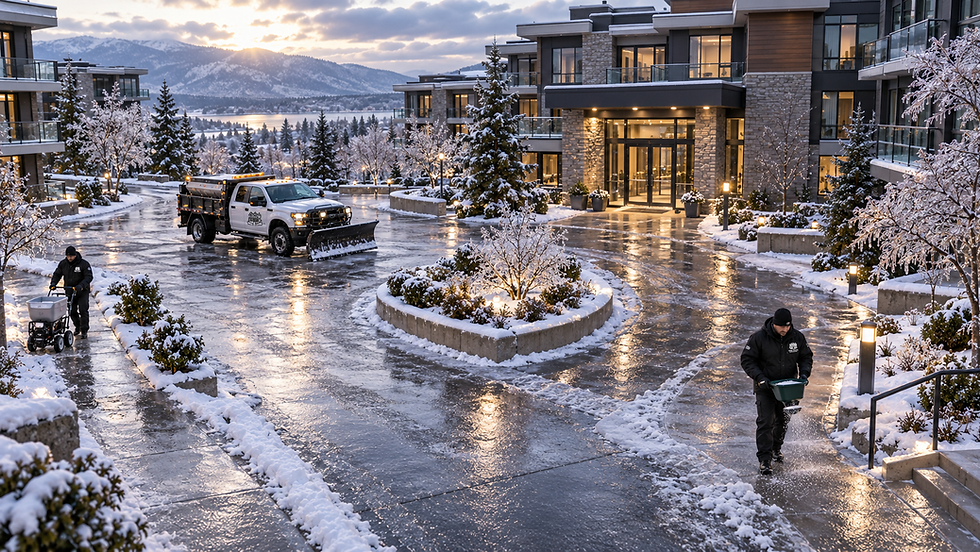
When the Pavement Glazes Without the Snow Piling Up
A snowfall trigger is easy to understand: once accumulation reaches an agreed depth, crews respond. Freezing rain can bypass that logic completely.
For a strata council reviewing Richmond ice and snow service, that difference matters because a property can develop hazardous walking and driving surfaces while recording almost no measurable snow accumulation. Rain reaches a surface as liquid and then freezes, creating a thin glaze that may affect sidewalks, stairs, ramps, parking areas, and vehicle entrances.
That is why a freezing rain snow contract should not depend exclusively on snow-depth thresholds. If the agreement effectively says “service begins after X centimetres of snow,” an ice event may fall into an operational gap.
The first question councils should ask is therefore not simply, “At what snowfall depth do you dispatch?”
It is, “What happens when precipitation freezes without producing plowable accumulation?”
For Only Strata Snow Removal, proactive dispatch and strata-specific planning are important because an ice event can require action even when a plow is not the primary tool.
Define Ice Response Separately From Snow Response
Properties throughout a complete Lower Mainland and Fraser Valley service area can experience rain, wet snow, freezing precipitation, thawing, and refreeze during the same broader weather system.
A contract should recognize that those conditions create different work.
Snow removal is largely an accumulation problem. Crews can mechanically move snow away from travel routes and pedestrian surfaces. Freezing rain is primarily a surface-condition problem. The operational focus shifts toward inspection, timing, traction management, material application, and return visits.
Give freezing rain its own trigger
An ice trigger can be based on forecast conditions, observed surface icing, freezing-rain alerts, site inspection, or another clearly defined service protocol.
The specific wording matters less than eliminating ambiguity.
If a contractor recognizes a developing ice event at midnight but cannot act because the contract only authorizes service after measurable snowfall, the agreement has created a delay exactly when timing matters most.
Specify which surfaces receive priority
Not every square metre of a strata property carries the same exposure.
Primary entrances, exterior stairs, accessible routes, sloped walkways, curb transitions, garbage access, and parkade approaches can require different priorities.
A useful ice storm service plan identifies those locations before the weather arrives rather than asking crews to invent priorities during the event.
One Weather System Can Demand Several Different Responses
The operational lesson behind How Winter Patterns In BC´s Lower Mainland Impact Snow Removal is that a winter event does not always remain one type of event from beginning to end.
Rain may arrive first. Temperatures can then fall. Freezing rain may develop, followed by snow or a later refreeze. A surface that was simply wet at 7 p.m. can require treatment several hours later even though little or no snow has accumulated.
This is where accumulation-only thinking becomes particularly weak.
Pre-treatment may sometimes be useful, but timing needs judgment. Material placed too early can be diluted or displaced during continued rainfall. Waiting too long, however, can allow ice to establish itself across heavily travelled surfaces.
Only Strata's proactive dispatch model helps address that timing problem. Large salt reserves also matter during prolonged ice conditions because material demand may continue through several treatment cycles rather than one initial visit.
Strict capacity limits add another operational advantage. Identifying an ice event does little good if every available crew is already committed to more properties than the contractor can realistically service.
The practical contract question is not simply whether “salting” is included. It is when treatment can begin, what triggers a return visit, and how changing conditions are verified.
The First Treatment May Not Be the Last
A freezing-rain event should rarely be thought of as a single service moment.
For related winter conditions in Delta, the first treatment may improve traction, yet additional precipitation can continue falling onto the same surfaces. Temperature changes, vehicle traffic, drainage, and runoff can also alter conditions after crews leave.
That means the contract should address reassessment.
Build follow-up into the service logic
A strong protocol can define circumstances that justify another property check, such as continued freezing precipitation, forecast temperature decline, resident reports, known drainage problems, or field observations from the first visit.
Only Strata uses GPS and photo service logs to document when crews attend and what they encounter. Those records can help the property manager understand whether a surface was treated once, revisited, or identified for further attention.
They also provide useful context after the storm. If one ramp repeatedly requires additional treatment while neighbouring surfaces remain stable, that information can improve the next winter plan.
Documentation is particularly valuable with ice because photographs and timestamps can show conditions that may change substantially within hours.
Contracts Should Explain What Happens When Conditions Change
A council considering nearby winter-service coverage in Vancouver should look beyond whether de-icing appears somewhere in the scope of work.
Ask how the contractor handles an event that develops differently from the original forecast.
Can crews be dispatched proactively within the agreed scope?
Who receives an alert when conditions deteriorate?
Does the contractor have enough material available for multiple applications?
Are follow-up visits included, separately authorized, or separately priced?
What happens when freezing rain transitions into snow?
How are inaccessible areas, unusual hazards, or property damage documented?
These are practical contract questions, not technical fine print.
A damage repair guarantee, such as the one offered by Only Strata, creates an additional accountability mechanism for legitimate service-related damage. Cancellation flexibility can also matter if the working relationship fails to meet expectations. Neither replaces clear ice-response language, but both contribute to a more complete service arrangement.
Most importantly, councils should avoid assuming that “snow and ice removal” automatically defines every decision. The operational process still needs enough detail to tell the contractor when to act and what follow-up is expected.

Write the Contract for the Storm That Leaves Nothing to Plow
The best test of a winter contract is not how clearly it describes a normal snowfall. It is how well it handles the event that does not fit the normal pattern.
Freezing rain is a perfect example.
Environment and Climate Change Canada treats freezing rain as a distinct weather hazard and issues warnings when expected ice accumulation can create hazardous walking or driving conditions. That alone illustrates why a snow-depth trigger is not a complete measure of winter risk.
For strata councils, the practical response is straightforward: define freezing rain separately, establish ice-response triggers, prioritize vulnerable surfaces, authorize appropriate dispatch, plan for reassessment, and make documentation part of the service process.
Only Strata Snow Removal supports that approach through its strata-only focus, controlled capacity, proactive dispatch, GPS/photo service records, substantial salt inventory, reliable winter response, cancellation flexibility, and damage repair guarantee.
A snowstorm leaves accumulation that is easy to see.
Freezing rain can leave almost nothing to plow—and still create the surface that demands the fastest response.


Comments